Pricing models
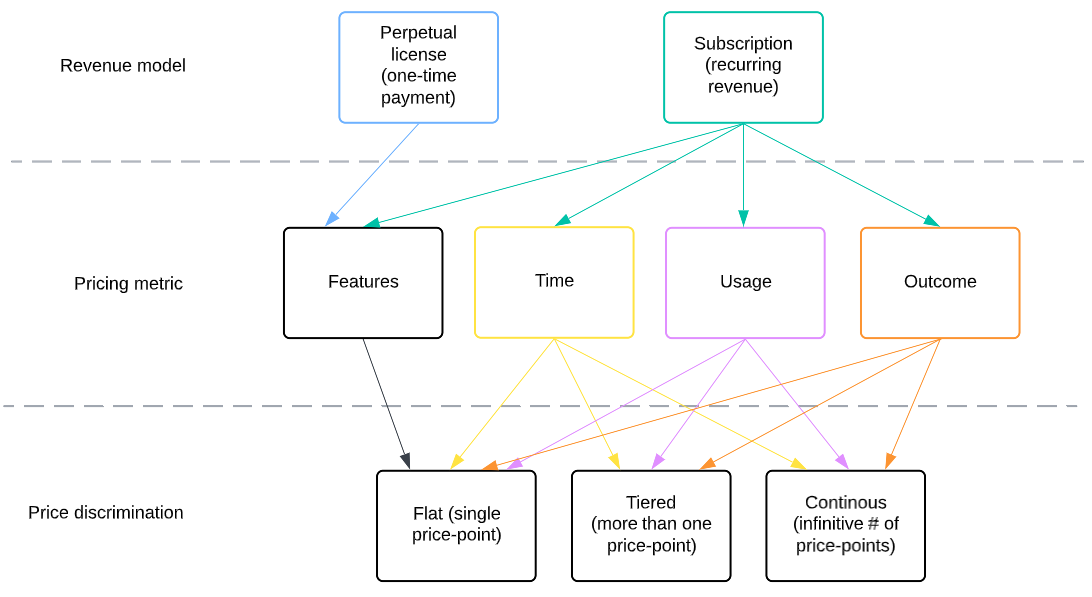
The three dimensions of the pricing model form the basis for determining the structure of monetization (Revenue model) to set up plans based on units of value exchange (Pricing metric) with customers and adjusting those plans to each customer segment (Price discrimination).
Pricing models
| Type | Guide |
| Area | Monetization, Strategy |
| Status | In progress |
The three dimensions of the pricing model form the basis for determining the structure of monetization (Revenue model) to set up plans based on units of value exchange (Pricing dimensions / Price metric) with customers and adjusting those plans to each customer segment (Price discrimination).
Contents
3️⃣ Pricing dimensions
The three dimensions of the pricing model form the basis for determining the structure of monetization (Revenue model) to set up plans based on units of value exchange (Pricing metric) with customers and adjusting those plans to each customer segment (Price discrimination).
💰 Revenue model
Revenue model tells you what relationship is between the fee that customers pay to software companies and the access they gain to the product.
1. One-time, up-front (Perpetual license)
Customers can hold the license and access the product indefinitely. However, they will not have access to ongoing product updates or technical support after a certain time—usually beyond a year of purchasing the perpetual license. This model allows adjusting the offer based on product version.
Typically, in order to keep revenue coming in, companies would need to release bigger and better versions of the software in the hopes of getting customers to upgrade—essentially selling the product again.
2. Recurring revenue (Subscription)
Customers pay a recurring subscription fee in order to access the product based on their subscription term. Customers lose access to the product if they stop paying.
The subscription model gives the flexibility to adjust pricing model to customer segments through suitable Price metric based on product version, time, usage or outcome.
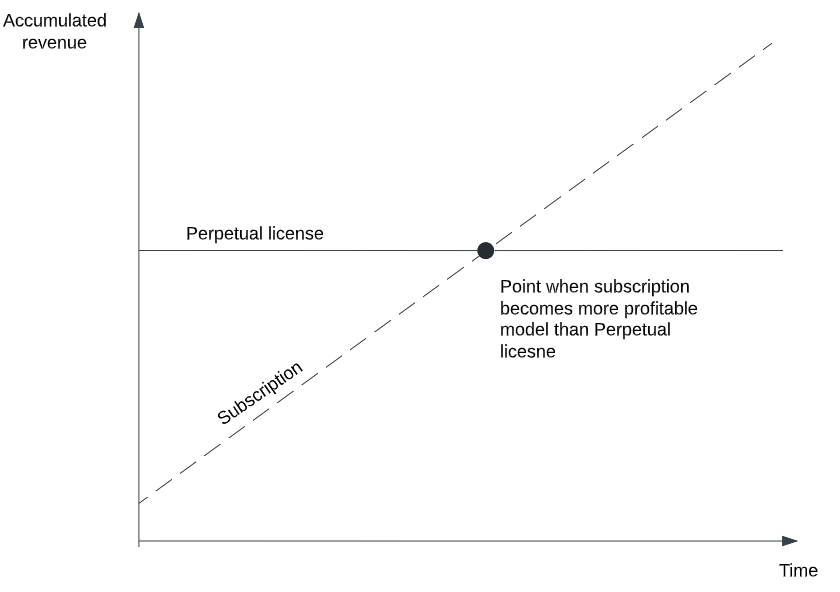
Recurring vs Up-front
Pros:
- Minimize entry threshold for customers
- Bigger revenue (potential) when customers stay
Cons:
- Costs are not covered from the beginning (cash flow)
- Potential risk of churn before return from investment
🔄 Subscription
Customer buys a subscription that includes the right to use the software, updates to new versions of software and support, rather than buying a perpetual right to use a product, along with the additional purchase of annual yearly maintenance.
Common subscription models based on chosen Price metric:
- Time of purchase — time-subscription, where revenue is generated based upon time (it's not the same as time of active usage; e.g. Slack pricing charges per seat within organization, not only for users who are active).
- Measure of consumption — Usage model, where revenue is generated based upon measurements of usage (e.g. number of analyses performed).
- Measure of outcome — Outcome model based upon achieving a specific outcome or measurable value, such as improvement in crop yield per year.
To each model a second layer of pricing is possible to add; see Price discrimination.
🤝 Price metric
A pricing metric is the way a company measures the per unit value of their product or service for sale.
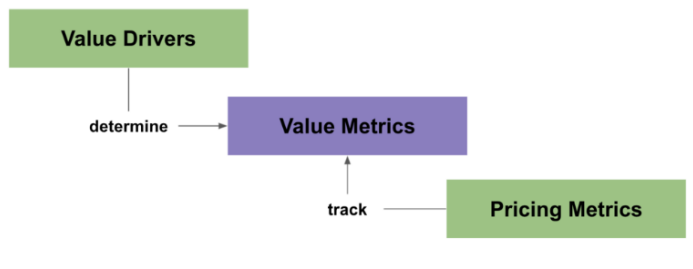
Before choosing a pricing metric, you should know the Value metric for your product or service. If the pricing metric is the unit of consumption that is priced, the value metric is the unit of consumption that creates value.
A price metric, however, allows you to have essentially infinite price points—maximizing your revenue potential. In practice, you'll never show infinite price points on your pricing page, sales deck, or mobile conversion page, but you may have a new customer come in at a certain level and then grow.
Four groups of price metrics (example: selling shoes; value metric could be):
- Pair of shoes (Features) — you're selling more pairs of shoes so you increase your revenue.
- Time of possession (Time) — each day of possessing your shoes by customer increases your revenue.
- Distance travelled (Usage) — each km on foot in your shoes travelled by your customer increases your revenue.
- Outcome — Outcome price metric is the same as Value metric, shows exact value exchanged with customer. Often it's difficult to set up Outcome metric for some use cases; usage metric is used as a proxy metric then.
The fundamental idea in value-based pricing is that the pricing metric should track the value metric. The simplest is to choose a pricing metric that is also a value metric. This is what we try to do as it generally makes everything simpler, from value communication and value delivery to value documentation. The classic example is Rolls Royce's Power by the Hour pricing: the airline does not buy jet engines but rather leases them and pays only for the time the engine is being used to power a plane. This is a very good matching of the pricing metric and value metric, and transformed the jet engine industry.
Example: Physical valves
Product: Physical valves with function and value provided by a combination of hardware and embedded software.
Possible monetization (3 layers):
- Revenue model — Selected to match the physical nature of the device and the associated capex purchase model. It is often perpetual, with software maintenance to provide service and updates. Selling with a perpetual model matches the perception that the device is a key element in a mission-critical factory and can't be allowed to stop running because of an expiration event for a time-based model.
- Price metric — The volume of liquid through the controller measured in gallons per hour.
- Price discrimination — Two options: base product (base value that controls flow through the valve) or add-on product (option that will automatically shut off the valve and send a message to the controller if there is a problem detected in the flow).
Four principles to create a pricing metric:
- The metric should be simple so that customers know what they are buying.
- The metric should represent a reasonable measure of value for the customer.
- A metric is best if it provides a way for the supplier to generate more revenue if usage or adoption of the product increases.
- Actual usage should be measured so that compliance, supplier fees and customer costs can be accurately determined.
How many pricing metrics?
One can be tempted to use multiple pricing metrics to try to get the pricing model to better track value or to accommodate different use cases and market segments. Our advice is to have only one or two variables combine into your pricing metric. This covers the majority of situations and most buyers can understand and accept a two factor pricing model. Things start to get much more complex with three pricing factors and complexity grows rapidly beyond three in a combinatorial explosion.
Pricing metrics and anchoring effects
One of the most important functions of the pricing metric is how it works as an anchor to help people understand what they are buying and how it will create value for them.
🤍 Value metric
What is a value metric?
A value metric is the way you measure value exchange in your product.
If the Price metric is the unit of consumption that is priced, the value metric is the unit of consumption that creates value.
Why use value metrics? Because people are not buying drills from you, they're buying holes. The same with shoes—you're not buying shoes just to have them, you're buying them to be able to walk from point A to B if that's your job-to-be-done.
The point is, products and services are just a tool to deliver value, which we exchange with our customers, usually for money. The better value metrics reflect delivered value, the more price becomes reasonable and justified from the customer's point of view.
Best practices
There are a variety of different offering structures that can be utilized to create multiple revenue streams from a single product or platform to match different market, persona and workflow requirements. This can be further extended to create different bundles of individual offerings or to create offerings as a combination of product function and product metrics.
Usage: How To Use Value Metrics To Optimize Pricing (priceintelligently.com) — Charging for each granular value add can run into problems. Performable (now part of HubSpot) and companies like MixPanel and Amplitude ran/run into this: analytical platforms charging "per event" makes sense to tie value to what you charge for, but there's no predictability in the costs per month. Their target (product and marketing decision makers) needed that predictability for procurement. A solution many use now is the banded approach, where they've figured out the distribution of their customers and essentially make tiers to align to that average usage.
📉 Price discrimination
In order to capture customers with differing jobs-to-be-done and varying willingness to pay, companies may introduce tiered pricing and secondary usage or outcome fees on top of their primary pricing model.
Tiered pricing is when a company creates different Subscription plans by limiting access to features or unit of price metrics for lower tier plans. For a usage-based pricing model, volume discounts can be considered as tiers if the enterprise paid for estimated usage up front as opposed to retroactively based on actual usage.
Tiered pricing is very common—overall, 91% of the SaaS companies whose primary pricing model we could classify had some form of price tiering.
Example: car rental
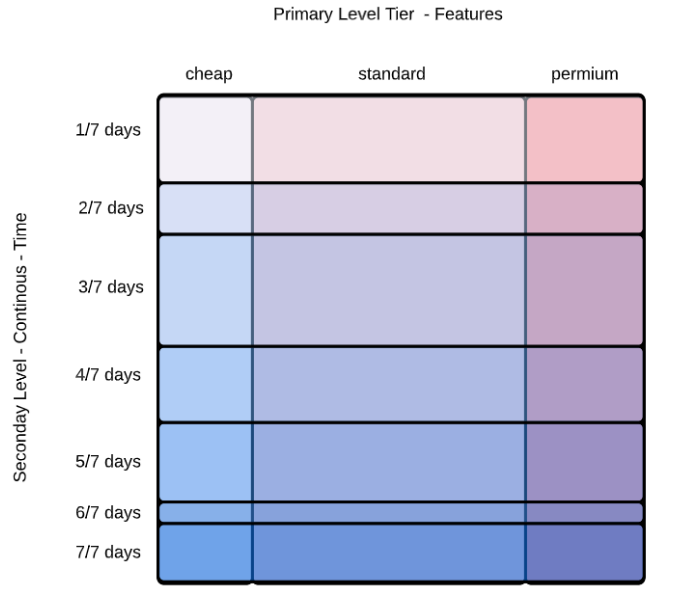
The square represents your TAM (total addressable market). As a company renting cars, you prepare 3 different versions of car (cheap, standard, premium) and a subscription plan based on price metric—time of renting (not time of usage).
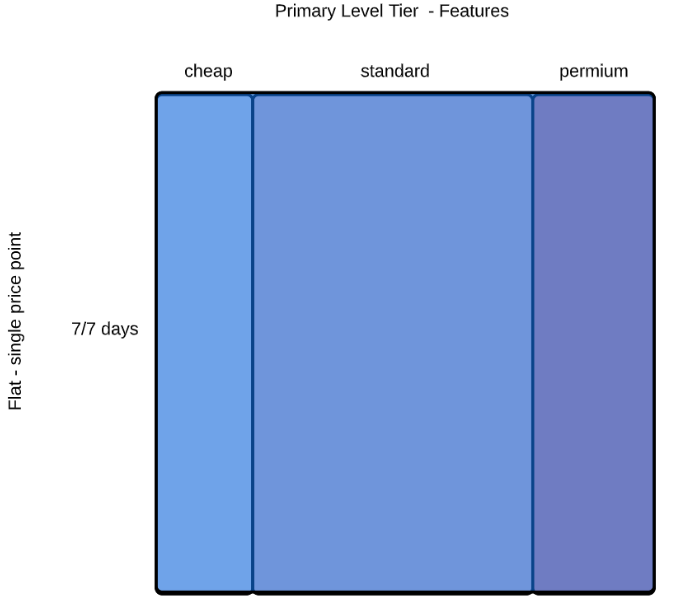
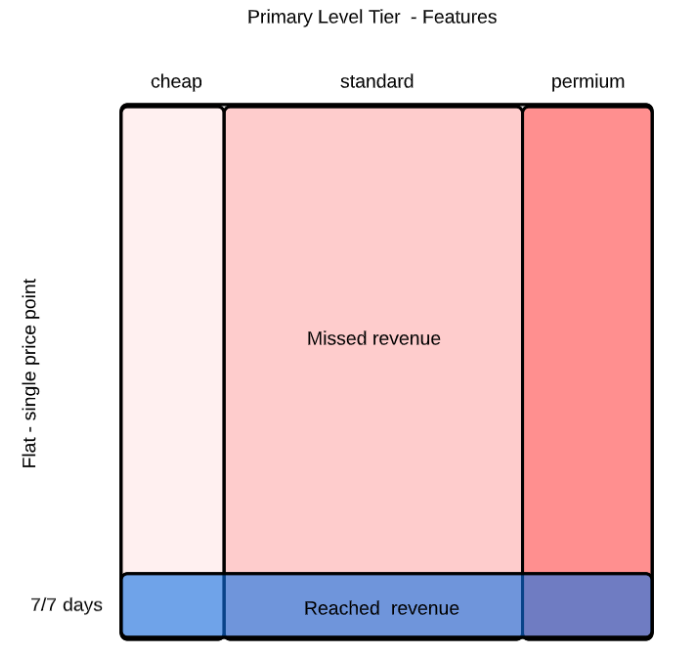
Rev: But it turns out that a set price for 7 days is not attractive for people who would like to rent a car for a shorter period. Your pricing model reaches only a part of the market, so you've missed revenue.
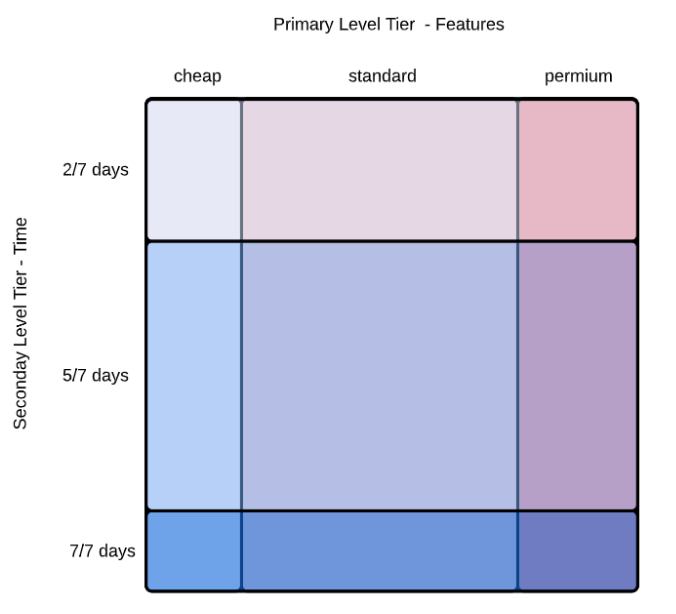
You've prepared new pricing models with more pricing-points to reach missed revenue. There are 3 customer segments:
- 1st segment — customers want to rent a car for a weekend
- 2nd segment — customers want to rent a car for 5 days to commute to work
- 3rd segment — customers want to rent a car for the whole week and use it constantly
You've tiered your subscription plan into 3 tailored plans to reach the whole market with slightly different needs or preferences.
But it turns out there are customers from:
- 1st segment who are only going on a one-day trip on the weekend—paying for two days is not attractive.
- 2nd segment who work remotely some days—paying for five days is not attractive; only ~10% of this segment find the plan suitable.
- 3rd segment, …
Again, you've missed some revenue from the market.
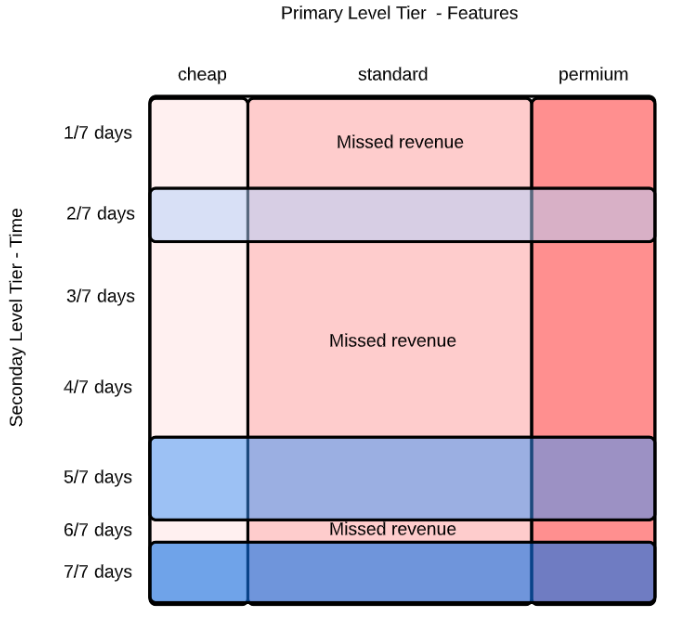
Continuous pricing — You've prepared new pricing models with more granular pricing-points to reach missed revenue. It allows you to address the whole market. Usually, there is no need to present all of those plans—customers pay for rent at the end of service or up-front as a declarative amount.